Free · Mongolia
What Does “Ger Tour Included” Actually Include?
Before paying for a Mongolia trip, find out what you will sleep in, who will take you there, and which costs are still yours.
Two Mongolia tours can show almost identical photographs: a ger beneath a wide sky, a vehicle on an open road, and a family serving tea. They may still be offering markedly different journeys. In one proposal, the ger is a bed in a staffed tourist camp, a guide travels with you, and most meals are arranged. In another, the accommodation is beside a herding household, the driver is your principal contact, and some meals and activities are paid separately.
Neither arrangement is inherently better. The trouble begins when you assume that “ger included” means the same thing in both quotes.
This article gives you a way to compare the essentials in one sitting. You do not have to be an expert on Mongolia, book through a particular company, or purchase another guide to use it.
The useful rule: Compare the service you will actually receive on each day, not the tour name or the number of scenic photographs.
Start with what “ger” does—and does not—tell you
A ger is the traditional portable, round dwelling widely associated with Mongolia. In a tour quotation, though, the word often tells you the kind of structure, not the level of accommodation or the human services around it.
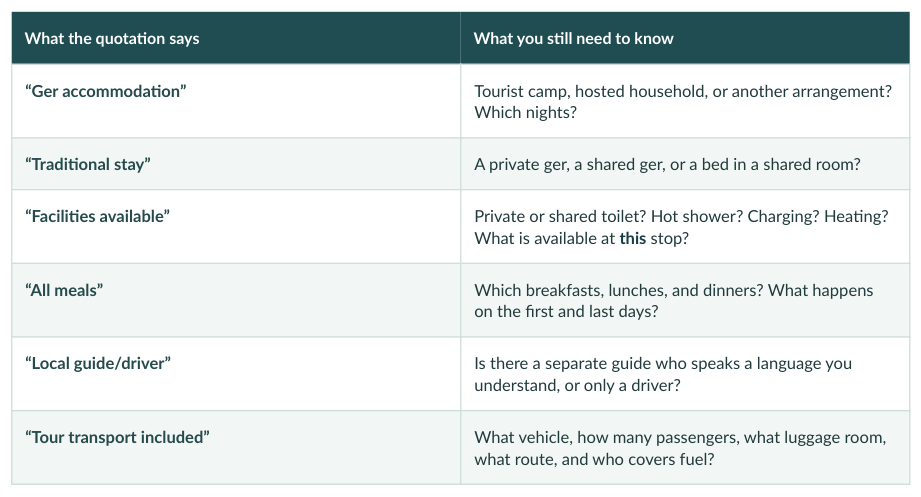
The following are different questions:
| What the quotation says | What you still need to know |
|---|---|
| “Ger accommodation” | Tourist camp, hosted household, or another arrangement? Which nights? |
| “Traditional stay” | A private ger, a shared ger, or a bed in a shared room? |
| “Facilities available” | Private or shared toilet? Hot shower? Charging? Heating? What is available at this stop? |
| “All meals” | Which breakfasts, lunches, and dinners? What happens on the first and last days? |
| “Local guide/driver” | Is there a separate guide who speaks a language you understand, or only a driver? |
| “Tour transport included” | What vehicle, how many passengers, what luggage room, what route, and who covers fuel? |
These distinctions are not imaginary. A Mongolia tour operator's published Gobi itinerary lists shared ger-camp accommodation, a separate English-speaking guide, internal flights, specific meals and activities, and exclusions such as optional activities and insurance. A separate Gobi camp (see Source 2) publishes its ger accommodation and dinner as distinct priced services. A local-government tourism listing (see Source 3) describes another camp's gers alongside shared service facilities. Actual operators publish different combinations of services; you must check the current offer rather than infer standards from the word ger. [1–3]
You do not need a luxury camp to enjoy a trip. You do need to know what you are agreeing to.
Read the offer as six small contracts
Imagine you have been sent this sentence:
“Four-day Mongolia ger adventure, private transport, local guide, accommodation and meals included, from $___ per person.”
That is an appealing headline, not yet a complete description. Turn it into six answers before paying.
1. Sleeping: where, with whom, and with which facilities?
Ask for a night-by-night accommodation list, not only a photo of a pretty ger. Include the first and final nights: those may be in Ulaanbaatar, near an airport, or elsewhere rather than in the countryside.
For each night, confirm the camp or host type, room/ger occupancy, beds, toilet and shower arrangement, heating if relevant, and where a phone can be charged. If the host is mobile or the stop is remote, ask how the final location and arrival instructions are communicated.
The phrase “comfortable ger” is not an answer to “Does the shower work at this site on my date?” Facilities can vary between stops on the same itinerary. Some travellers enjoy basic stays; others need a warm private room and reliable washing facilities. Both are legitimate preferences.
2. Getting there: transport means more than a vehicle photo
Ask the operator to name the road and travel pattern day by day: approximate driving hours, road surface where material, stops, and whether an internal flight or transfer is included. Clarify vehicle type, seating capacity after accounting for the driver and any guide, luggage allowance, and whether the vehicle is private to your group or shared with others.
For example, a tour may call its airport transfer “private” while using different transport for the rural segment. “Four-wheel drive” alone does not tell you how many passengers and bags will fit comfortably.
Mongolia's long rural distances and roads make time estimates particularly important. The Canadian government's Mongolia travel advice, last updated 9 October 2026, distinguishes many rural gravel/dirt roads from primary paved routes and recommends robust planning for remote travel. At the time of this article's research, it also warned of fuel shortages that could disrupt land and air transport. That is a dated condition to recheck, not a permanent description of the country. [4]
3. People: driver, guide, host, and specialist are not synonyms
Will the driver also explain the places you visit? If a guide is included, on which days will that person accompany you, and in which language can you communicate? If an activity requires a separate local leader, is that person part of the package? If you visit a household, is that a short hosted visit or a place where you will actually spend the night?
A helpful question is: “Who can explain the day's plans and handle a change when the driver is busy driving?” The answer matters especially to first-time visitors who do not speak Mongolian.
It is not a judgment on a driver's kindness or ability. It is about understanding the roles you are paying for.
4. Food and water: count meals, not adjectives
Ask for a simple day-by-day grid labelled B / L / D. Confirm which meals are provided on arrival and departure days, whether a packed lunch is used during long drives, and whether drinks and safe drinking water are included. Ask how to communicate dietary needs in advance, and distinguish “we will try to accommodate” from a confirmed arrangement.
If lunch is not included, where will you stop to buy or eat it? A low meal price is of little use when you are far from an obvious alternative. Conversely, a basic camp meal may suit you very well if you know what to expect.
5. Entry fees and experiences: identify the paid and optional parts
Write down what is included for each named stop: park or site admission, museums, a guided visit, horseback or camel activity, photography fees where applicable, and any equipment. Some activities may depend on weather, local availability, personal suitability, or an operator's conditions. Do not assume an activity is compulsory or available to every traveller.
Ask what happens if you decline or cannot do an optional activity. You should know whether you may simply rest, whether another activity is offered, and whether any prepaid amount is refundable under the agreed terms.
6. Changes and money: learn the rules before the deposit
For the exact dates and group size, ask for the total price and currency, what the deposit secures, the balance due date and payment method, and the written cancellation, substitution and refund terms. Clarify what happens if an internal flight changes, severe weather disrupts an itinerary, fuel is unavailable, or the minimum number of participants is not met. Ask whether the price is per traveller, per vehicle, or per private group—and whether solo occupancy or smaller groups change it.
Keep evidence of what the operator agrees to, including meaningful pre-booking answers. Insurance requirements, emergency assistance and current official travel advice should be checked independently. A statement that “travel insurance is excluded” does not tell you what a policy will cover. [4]
One example: the cheaper quote may not be cheaper for you
The following two proposals are fictional illustrations, not offers from real operators, price benchmarks, service guarantees or recommendations. Their “lower” and “higher” headlines do not represent actual market price tiers.
Both advertise a four-day countryside journey for two adults.
| Feature | Proposal Blue | Proposal Ochre |
|---|---|---|
| Headline price | Lower | Higher |
| Rural nights | “Ger stay” (camp not yet specified) | Two named tourist camps and one city hotel |
| Sleeping arrangement | Shared occupancy not explained | Two beds in a private ger each camp night, subject to confirmation |
| Vehicle | “4×4 transportation” | Private vehicle; stated passenger/luggage capacity |
| Human support | “Driver-guide” (language and duties unclear) | Driver and a separate English-speaking guide on specified days |
| Meals | Breakfast only, other meals extra | Exact B/L/D list for all four days |
| Fees and activities | Site fees, one activity extra | Named entry fees included; optional activities separately priced |
| Changes | “Non-refundable deposit” without detail | Dated cancellation and itinerary-change terms supplied |
What Blue needs before you can assess it: the operator may turn out to offer exactly what you want, but the quote leaves several large questions unanswered. Its lower number does not yet tell you the cost of meals, admissions and transport extras—or the actual sleeping arrangements.
What Ochre still needs: the words “subject to confirmation” are not a confirmed bed. You still need the final written accommodation details and the provider's precise change rules. A higher price and a better-looking document do not guarantee a better operator.
Notice that the decisive comparison is not simply cheap versus expensive. It is “Which plan gives my party the experience we want, at a price and with conditions we understand?”
The email that turns an attractive description into a usable quotation
You can copy this message and replace the bracketed fields. It is suitable for a paid tour, a customised private trip, or a ger stay packaged with transport.
Hello, thank you for the proposal for [dates / route / number of travellers]. Before we decide, could you please confirm in writing:
1. Accommodation: the type of ger or other lodging each night, whether we have a private sleeping space, and the toilet, shower, heating and charging arrangements at each stop;
2. Transport: the vehicle and realistic daily driving hours, whether our party travels privately or shares transport, and how luggage and fuel are handled;
3. People: whether a separate guide is included, the language spoken, and who is responsible if the plan changes;
4. Meals and activities: a day-by-day list of included meals, admissions, activities and any likely extras;
5. Payment and changes: the total amount for our exact party, currency, deposit and balance schedule, cancellation/refund terms, and what happens if weather, transport or a minimum-group requirement changes the itinerary.
Please also share the current full itinerary and the official contact for urgent help during the trip. We will review the answers before making payment. Thank you.
A clear written reply is more useful than a sales promise that everything will be “no problem.” If a provider cannot confirm a decisive detail yet, ask when and how it will be confirmed and whether you can cancel without loss if it does not meet your needs.
A five-minute final check
You are ready to compare offers when you can finish these sentences without guessing:
- We will sleep at [type and location] on nights [1, 2, 3…], with [privacy and facilities].
- We will travel in [vehicle/flight arrangement], for approximately [hours on each travel day].
- Our driver, guide and hosts will [specific roles and languages].
- The quoted price covers [named meals, entries, activities and transfers]; we would pay separately for [named extras].
- If a key part changes, [person/provider] will contact us through [method], and the written terms say [alternatives and refund consequences].
If any sentence is blank, you have found a question, not necessarily a reason to reject the trip. Ask it before you pay.
A good Mongolia tour does not have to include every comfort, every activity or an expensive guide. It should deliver the experience the traveller knowingly chooses. The best first step is not another hour of comparing photographs; it is a clear answer about the nights, days, people, money and changes behind them.
Sources and date-sensitive checks
Rechecked 24 October 2026. Actual prices, camp operation, route conditions, entry rules, and disruption advice can change. This article has not booked or verified a trip, provider, transport or accommodation on the reader's behalf.
- Discover Mongolia, “Mongolian Gobi Tour” — operator's published example distinguishing shared ger-camp lodging, meals, English-speaking guide, transport, inclusions and exclusions. https://www.discovermongolia.mn/tours/mongolian-gobi-tour . This is a real example of how inclusions can be described, not an endorsement or a guarantee of the current offering.
- TURTO Camp, Bayanzag, Gobi — at the 24 October 2026 check, the camp's homepage banner stated it is closed for the 2026 season. The same page describes its accommodation, amenities, separately listed breakfast/dinner arrangements https://turtocamp.com/ . The closure is a useful reminder to verify a specific camp's dates, not a recommendation to book a closed facility.
- Övörkhangai Province environment/tourism administration, Orkhon Tourist Camp listing — government-hosted listing illustrates a camp's gers and shared facilities; its published 2022 listing is not evidence of current opening or standards. https://www.nature.ov.gov.mn/d/baaz/48 .
- Government of Canada, “Mongolia travel advice,” updated 9 October 2026 — current-at-research-time transport disruption, remote roads, adventure-tourism precautions and official entry/safety context. https://travel.gc.ca/destinations/mongolia . Readers of any nationality should consult official advice applicable to them and the exact travel dates.

Location references
These Google Maps searches identify the places discussed here. Confirm the exact address and current access separately.